
In rural Gujarat villages, a handful of earthworms and a backyard pit are changing what women believe they can do.
The Share & Care Foundation has proudly partnered with Anjali Society for Rural Health & Development (Anjali), an organization that works alongside rural women to break cycles of poverty. Together, we focus on three deeply connected things: practical education, economic opportunity, and the confidence that comes when women see what is possible.
Here we share the story of how this partnership is helping women farmers learn new skills, try new ideas, and lead the way for their neighbors.
It is also the story of one remarkable woman, Laxmiben Rajubhai Parmar.
A Network of 2,400 Women
At the heart of Anjali’s work are women’s savings groups. Today, about 2,400 women across 53 villages belong to 180 groups. The groups are a place to save money, access small loans, learn, and support one another.
But the goal goes beyond savings. The long-term vision is the holistic development of every member. Each woman learns she can grow, become self-reliant, and pursue what she loves. These skills and mind-shifts become a platform for progress in income, education, health, and community life.
Most of these women come from families with small plots of land. Farming and raising cattle are their main sources of income. These women learned long ago to do more with what they already have, and our program helps them take it to the next level.
Learning by Seeing
Through the Share & Care Women Empowerment Signature Program, women from the savings groups have taken educational and inspirational tours to see new farming methods with their own eyes.
To promote sustainable farming without harmful chemicals, they visited well-run cattle stables and farms using organic and natural methods. In Gandhinagar, they met a woman who gets the most milk possible from just one acre of land. In Pratappura village, a farmer showed them his success with organic farming. Along the way, they got the rare chance to travel beyond their village and learned how to:
- Grow a dairy herd starting from a single cow or buffalo
- Care for cattle to increase milk production
- Treat crop diseases with traditional remedies instead of chemical pesticides
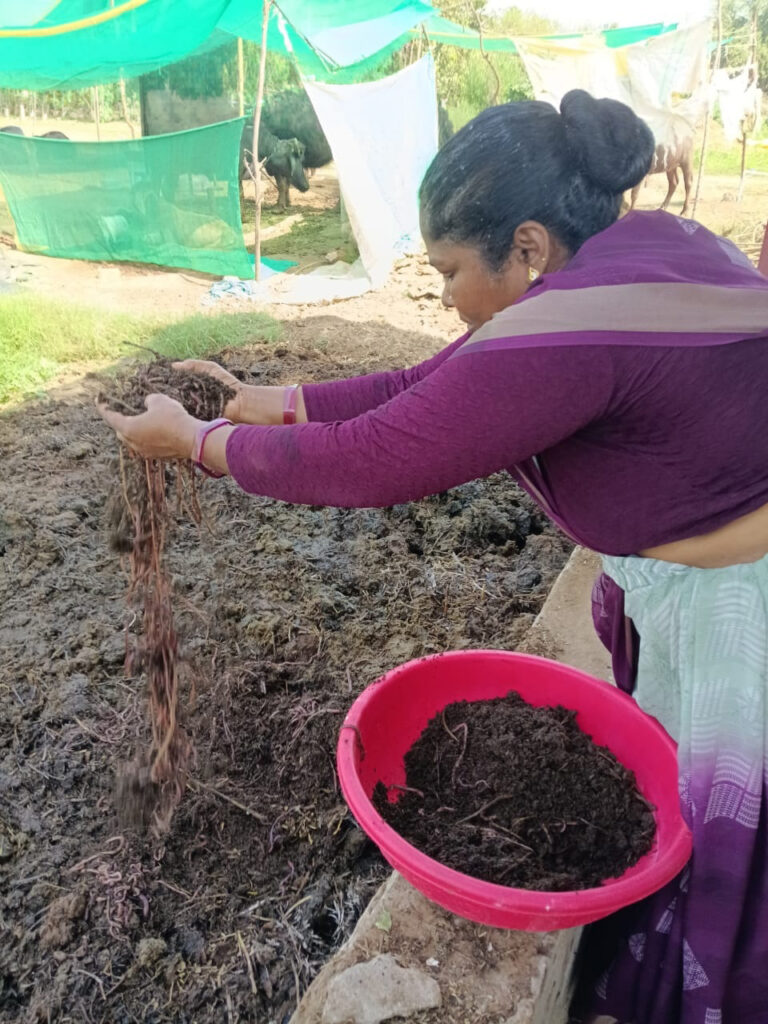
- Make vermicompost, a natural fertilizer made with earthworms
Additionally, they learned how chemical fertilizers and pesticides are linked to health problems like cancer, diabetes, and high blood pressure. Each year, they’re given vegetable seeds so they can keep growing pesticide-free food.
Change Takes Patience
The first challenge is changing old ways of thinking.
Chemical fertilizers promise bigger, faster harvests, and that is hard to walk away from when money is scarce. To keep costs down, the groups are encouraged to use the cow dung already in their backyards to make vermicompost.
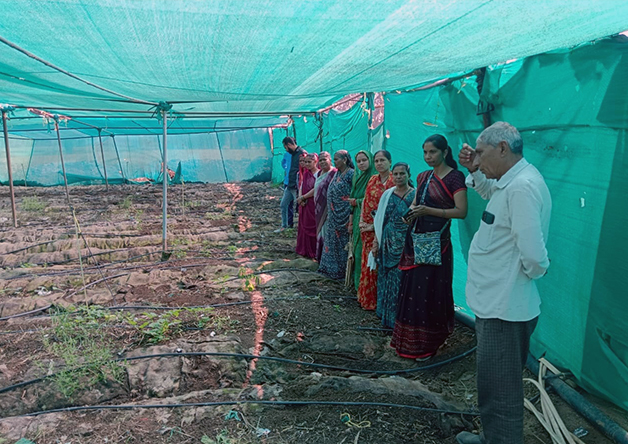
Participation in vermicomposting was low until 12 women agreed to take formal training in organic farming. They traveled to a farm in Rahiyol village near Ranasan. There, they saw the farmer’s wheat field, grown only with vermicompost, standing tall and green. From there, the farmer walked them through every step.
Each woman contributed ₹100 (the program covered the rest) to buy earthworms from him at ₹350 per kilogram (2 kilograms each).
Back home, the women dug pits behind their homes or in their fields, added dry dung and earthworms, and tended them daily. 45 days later, they had rich vermicompost as fine as tea dust!
Meet Laxmiben: A Real-Life Story of Resilience
Laxmiben Rajubhai Parmar lives in Bayal-Dhokhrol village. She has led the Gopi Mahila Savings Group since it began in 2012, along with 10 other members.
Laxmiben is a mother of four. She made sure both of her daughters earned master’s degrees in social work. One son completed an ITI technical course, and the other works in farming.
When Laxmiben was widowed, she thought hard about how to support herself and her family. With land for a small shop provided by the Gram Panchayat (village council) and a loan from her savings group, she started stocking seasonal household goods. She also keeps a sewing machine in the shop, so she can do tailoring work while serving customers.
Laxmiben is resourceful, hardworking, and always curious to learn something new. So when she saw organic farming in action, she wanted to try it on her own land. Back home, she started right away, closely following the vermicompost training.
Laxmiben, it turns out, is also an innovator. She had very little space behind her house, so she stitched a large plastic sack herself and made her compost inside it. The sack also kept out stray animals and birds, and the result was excellent, high-quality fertilizer.
Today, Laxmiben makes vermicompost regularly and uses it in her own fields. She has bred so many earthworms that she offers them to any woman who wants to start. She also shows her neighbors the healthy vegetables she grows with natural fertilizer, inspiring others to follow her lead.
Read more real-life storiesHow to Make Vermicompost, With Laxmiben
In this short video, Laxmiben greets viewers with “Namaste, sisters” and shows how she makes her compost, this time using a pit.
- Start with cow dung. Lay down a layer of cow dung as the base. Laxmiben and the women in the program used dung from their own cattle.
- Sprinkle with water. Moisten the dung so the earthworms have a comfortable home.
- Add the earthworms. Gently place the earthworms on top and spread them around.
- Water and wait. Sprinkle a little more water, then care for the compost daily. In about 45 days, it turns into dark, fine fertilizer.
Share & Care is Helping Grow More Than Crops
What starts with a few earthworms grows into something much larger. Women learn skills that cut farming costs and improve their families’ health. They gain the confidence to try new things and teach others. And families begin to see women as leaders in the fields and in the community.
Laxmiben’s journey shows what happens when determination meets opportunity. Through partnering with Anjali, the Share & Care Foundation is proud to help create those opportunities, one village, one savings group, and one woman at a time.
Want to help more women like Laxmiben build brighter futures? Learn more about our work and get involved at Share & Care Foundation.
How can I support this work?
Your support helps Share & Care Foundation continue partnering with organizations like Anjali to create opportunities for rural women.
SUPPORT THE WOMEN EMPOWERMENT PROGRAM TODAY